Binsar Travel Guide | A Dreamy & Unspoiled Destination In The Hills
Written in 2019, updated in October 2026. Prices and timings still change; check before you go.
When to go Binsar through the year
Easiest: Apr. Hardest: Jul, Dec to Feb. Tap + for the month-by-month weather and where these numbers come from.
- January: Hard. Daytime about 10°, night about -2°. Rain: some.
- February: Hard. Daytime about 13°, night about 0°. Rain: some.
- March: Mixed. Daytime about 17°, night about 4°. Rain: some.
- April: Easy. Daytime about 22°, night about 8°. Rain: some.
- May: Mixed. Daytime about 24°, night about 11°. Rain: wet.
- June: Mixed. Daytime about 25°, night about 14°. Rain: wet.
- July: Hard. Daytime about 20°, night about 14°. Rain: very wet.
- August: Mixed. Daytime about 19°, night about 14°. Rain: wet.
- September: Mixed. Daytime about 19°, night about 12°. Rain: wet.
- October: Mixed. Daytime about 18°, night about 8°. Rain: some.
- November: Mixed. Daytime about 15°, night about 4°. Rain: dry.
- December: Hard. Daytime about 12°, night about 0°. Rain: dry.
Approximate: ten-year averages from NASA POWER satellite data, adjusted for height; the figures can be a few degrees out. Conditions change; check before you go.
Where do these numbers come from, and how far can you trust them?
The figures come from NASA POWER, a free NASA project that publishes weather estimates for every point on Earth, put together from satellites and weather models. We took every day from 2015 to 2024 for this place, and averaged each month: the usual daytime high, the usual night low, and the rain.
Hills, mountains and islands are where this kind of data is least exact: the satellite sees an area roughly 50 km wide, not one town. We adjust for the height of the town, but the temperatures can still be a few degrees out, which is why you see a word for the day (Cold to Hot) and the night rounded to the nearest 5°, and why some places show the rain as bars with no numbers.
In very wet places the satellite data tends to run low in the rainy season, so the rain is drawn as bars, from the driest to the wettest month, without millimetre figures.
Easy, Mixed and Hard are our rule of thumb, not a forecast. Hard means days above about 37°, rain of about 250 mm a month or more, or nights close to freezing. Mixed means days above about 32°, rain over about 100 mm a month, or cold nights (below about 8°). Easy is everything else.
An average is not the weather on your dates, and it knows nothing about festivals, crowds, road closures or this year's monsoon. Check a forecast a week before you go.
Binsar! It’s all about a place far from the crowd and concrete jungle. Binsar is all about staying in the middle of forest & nature. In the blog post, we will explain why you need to head out for Binsar.
The Quick Answer
| You are asking | The answer |
|---|---|
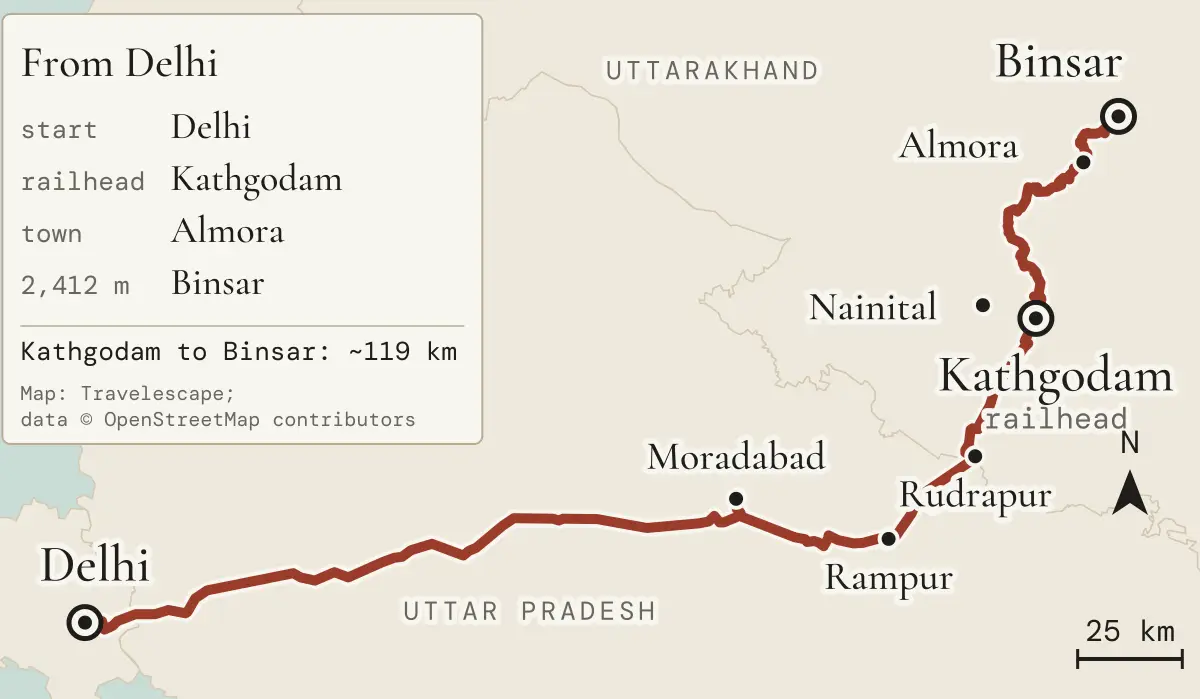
| How far is Binsar from Delhi? | About 380 to 420 km by road, nine to ten hours, by Moradabad, Rampur, Rudrapur, Haldwani, Kathgodam and Almora. The map below shows that road; open it in Google Maps for directions and today's traffic. |
| What is the easiest way from Delhi? | The Kathgodam Shatabdi (12040) leaves New Delhi early in the morning and reaches Kathgodam in about five and a half hours; from there it is 105 to 120 km by taxi, about four hours, to Binsar. Overnight, the Ranikhet Express (15013) or a bus to Almora. All the ways from Delhi. |
| Is there an entry fee? | Guides give ₹150 for an Indian adult and ₹250 for a car; ₹600 to ₹650 for a foreign visitor. We found no official list, so carry cash and ask at the gate. |
| Where do I stay? | Inside the sanctuary: the KMVN Tourist Rest House, about 2 km below Zero Point, or the forest rest house, booked through the forest office in Almora. Electricity comes for a few hours in the evening, or not at all. Outside: Almora, and homestays in the villages on the way. |
| When should I go? | April is the easiest month; October and November are the driest after the monsoon. July is the wettest, and January nights fall below freezing. The "When to go" box above has all twelve months. |
| What makes it different from Nainital? | No town: an oak forest protected since 1988, where the Chand kings of Kumaon kept a summer capital, with a view of Himalayan peaks from Kedarnath to Panchachuli. What makes Binsar different. |
| Is it safe? | Yes, with care: the forest burns in the dry months, a tiger was recorded here in August 2026, and the Almora road slides in the monsoon. Before you go. |
Before You Go (October 2026)
Fire. On 13 June 2024 a forest fire inside the sanctuary killed four of the eight people sent to fight it: a forest beat officer, a fire watcher, a Provincial Armed Constabulary constable and a daily-wage worker. April to June is fire season in these oak and pine forests. Do not smoke, light a fire or leave glass in the forest, and if you see smoke, tell the gate or your rest house.
Wildlife. In August 2026 a tiger was filmed in the sanctuary, at about 8,000 ft, and the forest department confirmed it and set up camera traps. Leopards have always lived here. The department asks visitors and villagers not to walk alone in lonely places at dawn or after dark, and to keep together. Walk with a guide, and be back at your room before dark.
The road. The Haldwani to Almora highway (NH 109) slides in the monsoon, worst at Kwarab, where in September 2025 heavy vehicles were stopped for about three weeks and traffic was sent round by Ranikhet, adding hours. Between July and September, check the road the day you leave and allow a spare day.
The other Binsar. The Binsar Mahadev temple near Ranikhet is a different place. For the sanctuary, set your map to Binsar Wildlife Sanctuary, on the road from Almora towards Bageshwar.
Binsar: A Natural Beauty
Whenever it comes to planning a trip to a hill station, we usually end up visiting Himachal Pradesh or the renowned hill stations of Uttarakhand like Nainital and Kausani. But the real fun comes from getting away from the urban areas and exploring the unspoilt. Plan a trip to Binsar to witness the real beauty of Mother Nature and spend some quality time.
Located at an elevation of approximately 2,412 m above sea level, Binsar is known for its immense natural beauty and pristine environment. Whether you are a writer, artist, poet, nature lover, photographer, adventure enthusiast, or just someone looking for a peaceful vacation, Binsar is the place to be.
To give you an idea about Binsar location. It is hardly 86 Km from Nainital, however you need to reserve 3 to 4 Hrs to reach the hill station from Nainital!
Binsar: Places to See & Visit
Binsar Wildlife Sanctuary
Binsar Wildlife Sanctuary is located on the top of Jhandi Dhar Hills with the Himalayas at the backdrop. The sanctuary is spread over an area of 45 sq km and is known for its rich flora and fauna. To get an insight into its diversity, you can pay a visit to the Binsar Sanctuary Museum. The museum has conserved a diversity of endangered birds, reptiles, and butterflies. (2026: the sanctuary covers 45.59 sq km, from 900 to 2,500 m. Its highest point, Jhandi Dhar, is the Zero Point, about 2 km on foot from the KMVN rest house.)
Binsar Mahadev Temple
The beautiful Binsar Mahadev Temple was built in the 9th century by King Kalyan Chand of Chand Dynasty. Although the presiding deity of the temple is Lord Shiva, you will also see idols of Goddess Durga and Parvati placed inside the sanctum. The lush green surroundings and the Himalayas at the backdrop makes the temple most suitable for meditation. (2026: the temple in the sanctuary is known locally as Bineshwar. The guides we checked agree it was built by a Chand king, Kalyan Chand, but date it anywhere from the 9th to the 16th century, and we found no record from the Archaeological Survey of India to settle it.)
Nearby Attraction From Binsar
Jageshwar
Located at a distance of approximately 45 km from Binsar is the beautiful temple of Jageshwar. The temple complex houses 124 shrines of stones dating back from 9th to 13th century CE. It is considered to be one of the most sacred tirthas of the Kumaon region and must not be left unexplored. (2026: it is a protected site of the Archaeological Survey of India, about 36 km from Almora. A second group of 15 temples, Dandeshwar, stands a kilometre or two before it on the same road.)
Almora
Almora, a picturesque town, is situated at a distance of approximately 33 km from Binsar. The snow-capped mountains, lush deodar forests, undulating mountain terrains and age-old temples add to the overall charm of the place. An insider’s guide to Almora gives you an insight about the place and helps you explore it better. (2026: 25 to 30 km to the sanctuary gate, depending on the source, by Kasar Devi and Kaphadkhan.)
What Makes Binsar Different
Most hill stations in Uttarakhand are towns with a view. Binsar is a forest with a few rooms in it. The sanctuary was set up in 1988 to save the broad-leaved oak forests of the Central Himalaya. There is no market inside, little electricity and no street light, and the nights are dark.
The kings and the commissioner. The Chand kings, who ruled Kumaon from about the 11th to the 18th century, kept Binsar as their summer capital. Under the British, Sir Henry Ramsay, Commissioner of Kumaon from 1856 to 1884, built a bungalow here on the Khali estate, where Vijaya Lakshmi Pandit, Nehru's sister, later lived. His summer home, Grand Oak Manor, is now a heritage hotel.
The view. On a clear morning Zero Point shows the Himalaya across Uttarakhand: Kedarnath, Chaukhamba, Shivling, Trishul, Nanda Devi, Nanda Kot and the peaks of Panchachuli. The rest of the time the forest is the show: rhododendrons in flower in March and April, and more than 200 kinds of birds, among them the Himalayan monal, Uttarakhand's state bird, and the kalij and koklass pheasants. The mammals are mostly heard rather than seen: leopard, goral, serow, barking deer, red fox and the red giant flying squirrel.
Rooted in Kumaon: Gods, Fairs and Old Stones
Binsar sits in the heart of Kumaon, and the roads around Almora pass some of its oldest and most living places.
Chitai Golu Devta. Golu Devta is Kumaon's god of justice. At his temple at Chitai, 8 to 12 km from Almora, people hang bells of every size and leave written petitions, asking him to settle what courts and families have not.
Kasar Devi. About 8 km from Almora, on the road to Binsar, the hilltop temple of Kasar Devi is old; how old, the sources do not agree. Swami Vivekananda came to Almora in 1890 and meditated in a small cave near the temple. The ridge beyond it, Crank's Ridge, drew writers, artists and seekers from the West through the 1960s and 1970s.
Jageshwar. In its valley of deodars, Jageshwar is still a place of worship, not a ruin, and it is busiest in Shravan, the monsoon month sacred to Shiva.
Lakhudiyar. About 20 km from Almora, the rock shelters of Lakhudiyar ("a hundred thousand caves") carry paintings of people, animals and patterns from the region's first inhabitants, thousands of years old.
Nanda Devi fair. Every September, at Nandashtami, Almora carries the goddess Nanda Devi through its streets, from the temple built in the reign of the Chand king Udyot Chand. It is the biggest week of the town's year; book early if your trip falls in it.
Aipan. Look at the doorsteps and prayer rooms of Kumaoni homes: the patterns in white rice paste on red earth are Aipan, drawn for festivals, weddings and the gods. Aipan has a Geographical Indication (GI) tag, as does Almora's Lakhori chilli, one of 18 Uttarakhand products tagged together in December 2023. Uttarakhand's first gallery of GI products opened in Haldwani, on the road from Delhi, in July 2026.
Best Places to Stay in Binsar
Flocked by tourists all year-round, Binsar offers good accommodation options. There are a number of hotels in Binsar ranging from budget to luxury.
Hotel Mountain Resort is among the most favourable places to stay in the region. Wherever you stay, the serenity and the panoramic view of the mountain ranges will make you gape in awe. (2026: we could not confirm that this hotel still trades under that name. Inside the sanctuary there are only the KMVN Tourist Rest House and the forest rest house, booked through the forest office in Almora. A homestay in a Kumaoni village is the other way to stay local: Uttarakhand's homestays are registered with its tourism board, and the family must live in the house, with six guest rooms at most. Ask for the registration before you book.)
Best Places to Eat in Binsar
Between Almora to Binsar lies the wonderful Mohan’s Retreat. It is the most favourable place and loved by locals and foreigners. You can also visit the Bird Song, The Acorn, Hotel Sunita Restaurant and Pandey Food Corner. Don’t forget to savour some local Kumaoni delicacies at these food joints. (2026: we could not confirm that each of these is still open; ask in Almora.)
WE RECOMMEND!
Try the local authentic food of the state. You can shop the local artifacts to take back home. This would certainly help local economy.
Kumaoni Food to Look For
Inside the sanctuary you eat what the rest house cooks, so eat Kumaoni in Almora, on the way in or out.
- Bal mithai and singori. Almora's own sweets, both made of khoya. Bal mithai, brown fudge rolled in white sugar balls, was first made in Almora's Lal Bazaar early in the 20th century; singori comes wrapped in a cone of maalu leaf. A GI tag for both was applied for in December 2025.
- Bhatt ki churkani. A dark curry of the local black soybean, thickened with rice flour, eaten with rice. Once a poor family's meal, now on the best menus.
- Aloo ke gutke. Potatoes tossed with a simple tempering, the snack at tea stalls across the hills.
- Madua roti. A flatbread of finger millet, eaten with ghee or a chutney of hemp seed (bhang ki chutney: the seed, not the intoxicant).
- Kafuli. Spinach or fenugreek greens, ground and simmered thick.
Buying Almora's sweets, Lakhori chillies or an Aipan piece from the people who make them is the simplest way to leave money in the hills, as the note above asks.
Getting Around Like a Local
Almora is the hub. From Kathgodam, shared taxis and Uttarakhand Transport Corporation (UTC) buses run up to Almora; from Almora, a local taxi takes you the last 25 to 30 km by Kasar Devi and Kaphadkhan to the sanctuary gate, about 3 km beyond Kaphadkhan, where the entry formalities are done. We found no regular bus to the gate.
Inside, walk. The walk to Zero Point, about 2 km from the KMVN rest house, is the one to do, early, when the peaks are clearest. For the forest trails, take a guide (guides list ₹600 for half a day and ₹1,200 for a full day; we could not confirm these). Be back before dark.
Two days out. One day for Almora: Kasar Devi on the way, Chitai Golu Devta, the Nanda Devi temple and the bazaar for bal mithai. One day for Jageshwar and Dandeshwar, with Lakhudiyar if you leave early.
Best Time to Visit Binsar
Though you can plan a trip to this idyllic hill station any time of the year, but the months from April to June are the most favourable. The temperature during this time of the year hovers between 10 to 20 degree Celsius. (2026: the "When to go" box at the top gives April as the easiest month, days about 22° and nights about 8°; May and June are warmer and wetter, and the forest's fire season. October and November are the driest months after the monsoon, the time to see the peaks, with cold nights.)
The lush greenery and the pleasant weather makes this hill station a perfect escape from the scorching heat of the cities. Also, those who want to enjoy snow can visit this hill station during winters. Bonfires with snow-capped mountains in the backdrop and a cold weather makes for a perfectly romantic setting. (2026: in January nights fall below freezing. After the fire of 2024, light no fire in the forest yourself; ask your rest house.)
Binsar:Latest Weather & Forecast
(2026: the twelve months, with day and night temperatures and rain, are in the "When to go" box at the top of this page.)
Some Tips for Your Hassle Free Travel
- Carry light winter clothes even when you are visiting this hill station during summers.
- Don’t forget to carry your sports shoes with you.
- An SPF 50 sunblock is a must when you are in a hill station.
- Carry enough cash with you as you might not find many ATMs on the way.
- If you suffer from nausea while travelling in a hill station, travel empty stomach or take some medicine.
- Don’t go for a trek when it’s dark as you might encounter wild animals.
Binsar Hill
How to Reach Binsar: Best Suggested
By AirPantnagar Airport is the nearest airport, which is located at a distance of approximately 152 km; time of travel from Binsar. Flights from this airport ply to cities like Chandigarh and Delhi on a daily basis. On arrival at the airport, you can book a taxi to travel to Binsar, which will cost you approximately 1500 INR. (2026: Pantnagar is 127 to 152 km from Binsar, depending on the source. In 2026 IndiGo flies it to and from Delhi, in about an hour; we found no current flight to Chandigarh. We could not confirm today's taxi fare, so agree it before you set off.)
By Rail
Travelling to Binsar by railways is a good idea. Kathgodam Railway Station, at a distance of approximately 119 km, is the nearest railway station. Some trains that ply from Delhi to Kathgodam on a daily basis include Ranikhet Express and Sampark Kranti. You can later opt for a shared taxi or a private one to reach Binsar. (2026: the fastest is the Kathgodam Shatabdi, 12040, from New Delhi; see "From Delhi" below.)
By Road
Travelling to Binsar by road is by far the most convenient way to travel as Binsar is well-connected by motorable roads. Buses and taxis are easily available from all the nearby areas like Haldwani, Almora and Nainital. You can take a bus from Delhi to Almora and then a taxi to reach Binsar.
ROUTE TO FOLLOW
Option 1 : Delhi – Moradabad – Thakurdwara – Kashipur – Ramnagar – Corbett – Ranikhet – Almora – Binsar
Option 2 : Delhi – Moradabad – Rampur – Bilaspur – Rudrapur – Haldwani – Kathgodam – Bhimtal – Bhowali – Almora – Binsar
(2026: the map at the top of this guide draws Option 2, about 418 km in OpenStreetMap. Option 1 is the way round when the Kwarab stretch of the Almora road is closed.)
From Delhi: Train, Bus, Flight or Car
Every way in from Delhi ends with the same climb: from the plains at Kathgodam or Haldwani, about four hours up through Bhimtal, Bhowali and Almora.
| How | From Delhi | Time | Cost (October 2026) |
|---|---|---|---|
| Day train | Kathgodam Shatabdi (12040) from New Delhi, early morning; a taxi from Kathgodam | About 5½ hours to Kathgodam, then about 4 hours by road | Train fares on IRCTC; the taxi agreed on the spot |
| Night train | Ranikhet Express (15013), leaving Delhi about 10 pm | Reaches Kathgodam about 5 am, then about 4 hours by road | Train fares on IRCTC; saves a night's stay |
| Bus | Anand Vihar to Almora, mostly overnight (UTC and private operators), then a taxi | About 10 hours to Almora, then about an hour | From about ₹655 on booking sites |
| Flight | IndiGo to Pantnagar, then a taxi | About 1 hour, then 4 to 5 hours by road | Varies by day; the dearest way |
| Car | By Moradabad, Rampur, Rudrapur, Haldwani, Kathgodam, Bhowali and Almora | 9 to 10 hours, 380 to 420 km | Fuel and tolls; your own pace |
Our suggestion. Take the morning Shatabdi and reach Binsar before dark, or take the night train and watch the hills come up at dawn. The Uttarakhand Sampark Kranti (15035) also runs to Kathgodam. Driving, leave Delhi early to clear the plains, and do not drive the hill road after dark. Train times change: check them on IRCTC before you book. With only a weekend, Mussoorie is nearer: Himani Nailwal's Delhi to Mussoorie trip takes two days for about ₹6,000.
If Kumaon leaves you wanting more of Uttarakhand, Garhwal is the other half: the four Badris and the Char Dham.
Google Maps: Routes Planner
(2026: open the route from Delhi in Google Maps.)
Concluding Remarks: Key Takeaway
Some travel to explore, some travel to learn, but some just travel to spend some time in the lap of mother-nature. If you are among those, plan a trip to Binsar soon and rejuvenate your body and soul.
Keep Calm and Keep Exploring!!
Dear Readers, Thank you for reading my post, if you like please leave us a “feedback by clicking the stars” or by your comment!
Thank you. Your comment will appear here once Nilabh has read it, usually within a few days.
That didn’t go through. Please check your name, email and comment and try again, or write to nilabh@travelescape.in.
Comments
Start the conversation.
Every comment is read before it appears here. Your email address is never shown; you get one email when your comment is up.